
Packaging Automation with Industrial Robots
Packaging automation with industrial robots covers the handling steps between the product and the packaging machine: cartons, trays, lids, inserts, bottles and finished packs. The robot is useful where formats change and where a person is still doing the loading.
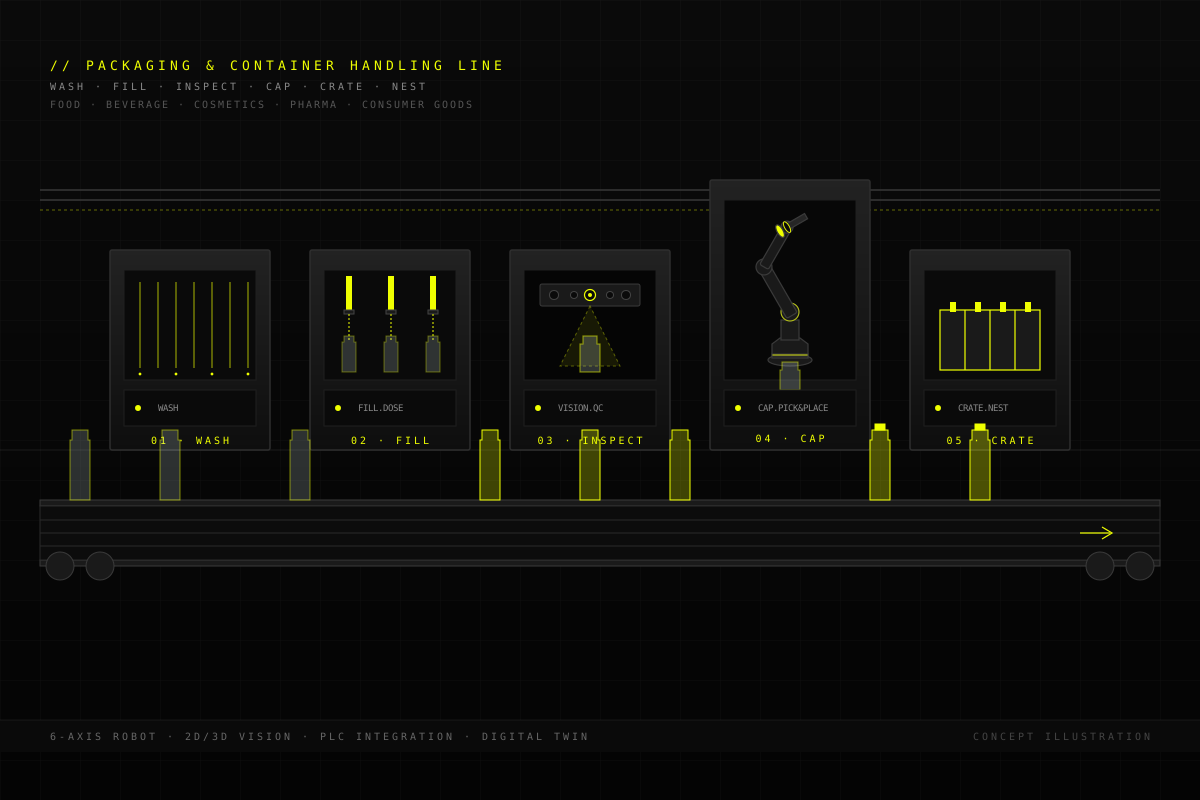
What the task looks like on the shop floor
Packaging lines are built around dedicated machines: fillers, cappers, cartoners, case packers, labellers. Between those machines, people still do a surprising amount of work. They load blanks and trays into magazines, place inserts, orient lids, unscramble bottles, collate products before the case packer and handle rejects. These tasks are repetitive, format-dependent and often sit on the critical path of the line.
Hard automation solves each of these tasks for one format. When the product mix grows, every new carton size, tray or bottle shape means a new change part, a longer changeover and another chance for a jam. A vision-guided 6-axis robot can absorb part of that variability, but only if it is connected properly to the packaging machine it feeds and to the line PLC that runs it.
Typical situations
- Manual loading of packaging machines from stacks, trays or bulk containers
- Frequent format changeovers with dedicated change parts for each SKU
- Products arriving in variable position or orientation before the packaging step
- Placing inserts, lids or leaflets that a dedicated machine cannot handle reliably
- End-of-line collation, pack pattern forming and reject handling done by operators
- Small or seasonal batches where a dedicated packaging machine is hard to justify
When a robotic application makes sense — and when it does not
An honest fit check is the first thing we do. Not every task needs a robot, and not every robot task needs vision.
It usually makes sense when
- One station must handle several packaging formats or SKUs without mechanical change parts
- Products or packaging components arrive in variable positions and vision is needed before placement
- A robot can replace a manual loading step at the infeed of a packaging machine
- Cycle time per item is in the range a 6-axis robot can hold, or a buffer decouples the robot from the line
- The robot can be integrated with the packaging machine PLC for a clean handshake, stop and restart
- A packaging machine builder needs a flexible handling module around a standard machine
It usually does not make sense (yet) when
- A single stable format runs at high speed: a dedicated mechanical packaging machine is simpler, faster and cheaper
- Line speed is far above what a robot can reach and no parallelisation or buffer is possible
- The packaging component is too flexible, too light or too deformable to grip and place consistently
- The packaging machine has no usable interface and cannot be stopped or synchronized safely
- Line layout leaves no space for a guarded robot cell or a safe access concept
What we typically use
- 6-axis industrial robots
Reach, payload and speed sized to the packaging format and line rate
- 2D/3D integrated vision
Locating products, cartons, trays and lids before pick and place
- Grippers for packaging
Vacuum, mechanical and format-flexible end-effectors for cartons, trays, bottles and inserts
- PLC integration
Handshake with packaging machines and the line PLC, format recipes, faults and recovery
- Digital twin validation
Simulation tools such as NVIDIA Isaac Sim for reach, collision, layout and cycle checks
- Adaptive robotics
Physical AI for grasping and placement only when deterministic automation is not flexible enough
From task to validated robotic application
We start from the production task, not from the robot. Each step reduces technical risk before the next investment.
- Step 01
Assessment on your line
We start from your packaging formats, line rate, changeover pattern and the machine the robot has to feed. The goal is to decide whether a robot beats a mechanical solution for your case.
- Step 02
Handling and vision tests
We test gripping and vision on your real cartons, trays, lids or bottles, including the worst formats, before any robot or camera is selected.
- Step 03
Digital twin and pilot cell
We validate reach, collisions, layout and cycle assumptions in simulation, then build a robotic pilot cell with the real gripper, camera and packaging components.
- Step 04
Integration with the packaging machine
We integrate the robot with the packaging machine and line PLC, together with the machine builder and with mechanical, electrical and safety partners for the final cell.
Related services: Robot Application Assessment, Digital Twin Validation, Robotic Pilot Cell, PLC / Robot Integration.
Often combined with
- Bottle & Container HandlingHandling, transfer, sorting or loading of bottles, jars, cups, cans and containers.
- PalletizingRobotic palletizing and depalletizing concepts for production and end-of-line automation.
- Vision-Guided Pick & PlaceRobot applications where part position, orientation or format changes and vision is required before motion.
- PLC / Robot IntegrationPLC-connected robot applications, machine handshake, safety states, I/O mapping and industrial software integration.
Loading a packaging machine by hand?
Tell us which formats you run, the line rate and which machine the robot would feed. We can tell you whether robotic packaging automation is realistic for your line and what the first technical step would be.