
Vision-Guided Industrial Robotics for Manufacturing Automation
TrainIt Robotics designs, validates and integrates industrial robotic applications using 6-axis robots, integrated vision systems, PLC-connected software, digital twins and adaptive robotics.
From machine tending and bin picking to packaging handling, sorting, inspection, palletizing, welding support and custom robot integration.
Based in Châtel-Saint-Denis, Switzerland · Working with manufacturers, OEMs and system integrators
- AssessTask, product, cycle, risk
- ValidateDigital twin or pilot cell
- IntegrateRobot, vision, PLC
- DeployWith mechanical & safety partners
Who are you, and what do you need to automate?
Three entry points. Pick the one that matches you — each page speaks your language and leads to the right next step.
Automate Manual, Repetitive or Unstable Production Tasks
Robotic automation for manufacturing tasks such as loading/unloading, machine tending, pick and place, packaging handling, palletizing, sorting, inspection and PLC-integrated robotic cells.
Solutions for ManufacturersFor Machine Builders & IntegratorsAdd Vision-Guided Robotic Modules to Your Machines
Support for OEMs, machine builders and system integrators developing robotic modules, vision-guided handling, bin picking, adaptive manipulation, digital twin validation and PLC/robot integration.
Solutions for Machine BuildersFor Robotics EngineersLearn Industrial Robotic Manipulation
ROS2, MoveIt2, Isaac Sim, Isaac Lab, digital twins, computer vision, PLC integration and industrial robotic software architecture through TrainIt Academy and Learn Robotics with ROS.
Explore AcademyIndustrial Robotic Applications
TrainIt Robotics helps validate, prototype and deploy robotic applications across manufacturing, packaging, machine building and industrial automation.
Machine Tending
Robotic loading and unloading of machines, fixtures, trays, stations and process equipment.
Learn moreBin Picking
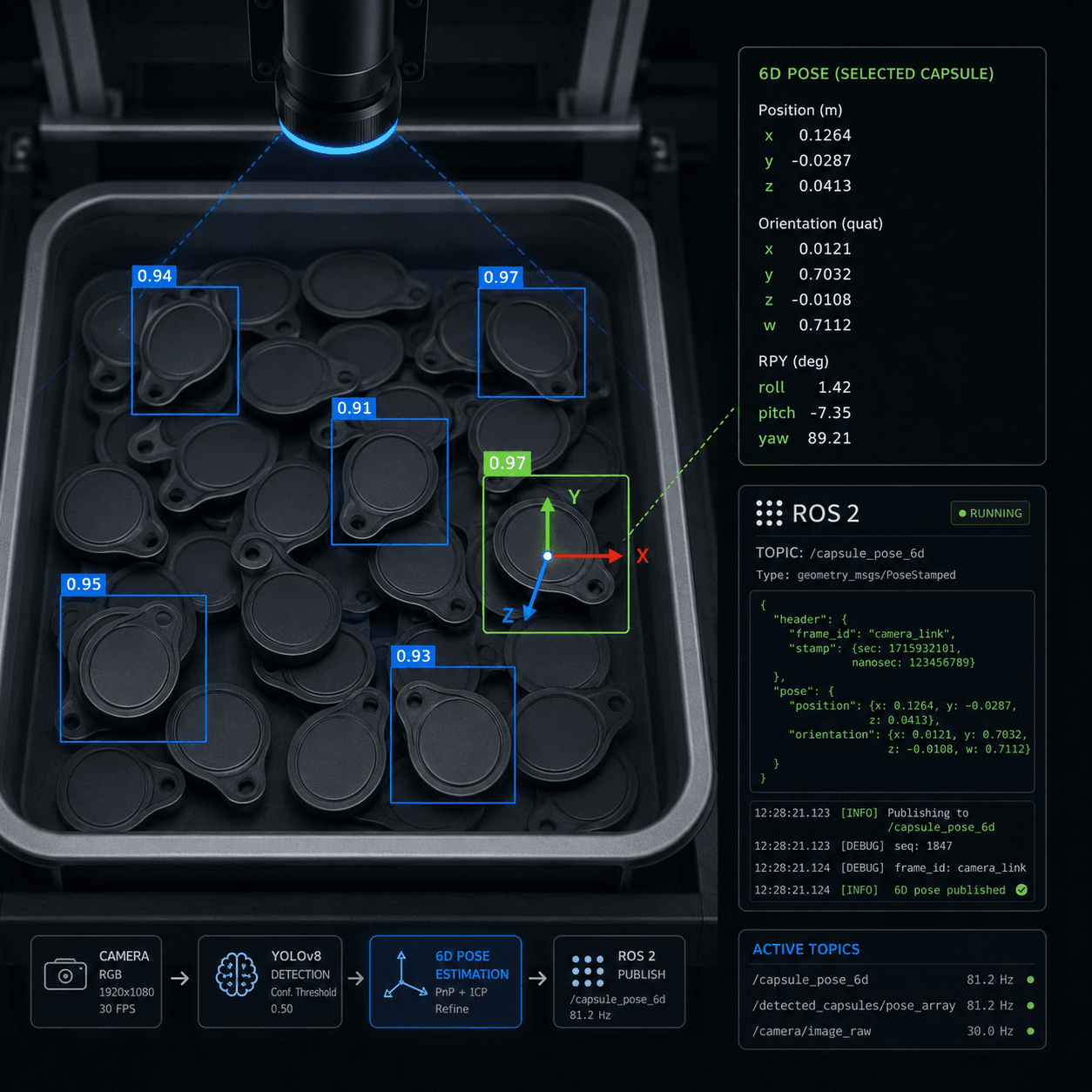
Vision-guided picking of randomly oriented parts from bins, trays or containers.
Learn moreVision-Guided Pick & Place
Robot applications where part position, orientation or format changes and vision is required before motion.
Learn morePackaging Handling
Robotic handling of packaging components, containers, bottles, lids, trays, cartons and end-of-line products.
Learn moreBottle & Container Handling
Handling, transfer, sorting or loading of bottles, jars, cups, cans and containers.
Learn morePalletizing
Robotic palletizing and depalletizing concepts for production and end-of-line automation.
Learn moreSorting
Robotic or vision-guided sorting of parts, products or packaging formats.
Learn moreVisual Inspection
Vision systems for part detection, pose estimation, presence control and quality inspection support.
Learn moreWelding Support
Robotic welding concepts, vision-assisted positioning and industrial robot integration support.
Learn morePLC / Robot Integration
PLC-connected robot applications, machine handshake, safety states, I/O mapping and industrial software integration.
Learn moreRobotic Pilot Cells
Small-scale robotic pilots to validate a task before investing in a full production cell.
Learn moreDigital Twin Validation
Simulation-based validation of robot reach, collisions, cycle assumptions, layout and process logic.
Learn more
From Industrial Task to Robotic Application
We start from the production task, not from the robot. The goal is to reduce technical risk before committing to a full robotic cell.
- Step 01
Application Assessment
We analyze the process, product, cycle time, constraints, operators, fixtures, variability and automation risk.
- Step 02
Concept & Feasibility
We define robot, camera, end-effector, layout, PLC interface, integration constraints and technical risks.
- Step 03
Digital Twin / Pilot Validation
We validate reachability, collisions, cycle assumptions, process sequence and application logic before full deployment.
- Step 04
Deployment with Partners
We integrate the robotic application with mechanical, electrical and safety partners when the project requires full cell deployment.
- Step 05
Support & Improvement
We help optimize cycle time, reliability, new formats, recovery behavior and future extensions.
Every project starts with a technical discussion to define scope, risk and the most appropriate next step. Start the discussion →
When Deterministic Automation Is Not Flexible Enough
Some industrial tasks are difficult to solve with fixed fixtures and deterministic programming alone. Parts may arrive randomly, products may change position, formats may vary, or the robot may need to perceive the scene before acting.
For these cases, TrainIt Robotics uses vision-guided robotics, digital twins, simulation, adaptive manipulation and Physical AI techniques when useful — as engineering tools, applied only where they reduce risk or add flexibility.
- Random part orientation
- Variable product position
- Changing formats
- Bin picking
- Adaptive robot behavior
- 2D/3D vision
- Simulation before deployment
Robotics Engineering Services
Concrete, scoped engineering steps — from a first assessment to a deployed robotic cell. Each one can be bought on its own.
- Service 01
Robot Application Assessment
A practical technical assessment to understand whether an industrial task can be automated, what the risks are, and what robot, vision system, end-effector and PLC architecture would make sense.
What is included → - Service 02
Digital Twin Validation
Simulation-based validation of robot reach, cell layout, collisions, cycle assumptions, process sequence and integration constraints before building hardware.
What is included → - Service 03
Vision-Guided Robotics
Integration of industrial cameras, 2D/3D perception, pose estimation and robot motion for applications where product position or orientation changes.
What is included → - Service 04
Robotic Pilot Cell
Small-scale validation of a robotic application using real products, robot motion, vision and basic industrial interfaces before full deployment.
What is included → - Service 05
PLC / Robot Integration
Industrial robot integration with PLC-controlled machines, I/O handshake, machine states, alarms, recipes, safety logic interfaces and production sequences.
What is included → - Service 06
Robotic Cell Deployment
Deployment of robotic applications with 6-axis robots, vision systems, PLC-connected software and mechanical, electrical and safety partners when required.
What is included →
Built by Industrial Robotics and Automation Engineers
TrainIt Robotics is built on hands-on experience in industrial automation, robotics software, machine vision and production machinery.
The founder is a former Tesla engineer with experience across pharma, cosmetics, consumer goods, food and automotive manufacturing. His background includes programming and commissioning industrial machines with Beckhoff TwinCAT and Siemens TIA Portal, working on high-speed production lines up to 350 parts per minute, and developing complex robotic machinery with integrated vision systems.
TrainIt combines traditional industrial automation expertise — PLCs, motion control, machine sequences, I/O, safety interfaces and commissioning — with advanced robotics tools such as ROS2, MoveIt2, NVIDIA Isaac Sim, NVIDIA Isaac Lab, digital twins, computer vision and edge AI.
This combination allows TrainIt Robotics to work on both deterministic industrial automation and more flexible vision-guided robotic applications where product position, format or environment variability matters.
Industrial background
- Former Tesla engineering experience
- Beckhoff TwinCAT / Siemens TIA Portal
- High-speed machinery up to 350 parts/min
- 6-axis robot applications
- Integrated vision systems
- Digital twin and simulation
- NVIDIA Isaac Sim / Isaac Lab
- Pharma, cosmetics, consumer goods, food and automotive
Have an Industrial Task That Could Be Automated?
Send a short description, video or process information. TrainIt Robotics can help you understand whether a robotic application makes sense and what the next technical step could be.