
Bin Picking Robots for Industrial Applications
Bin picking lets a 6-axis robot pick parts that arrive in random positions and orientations — without feeders, dedicated fixtures or manual pre-sorting. It is a vision problem before it is a robot problem.
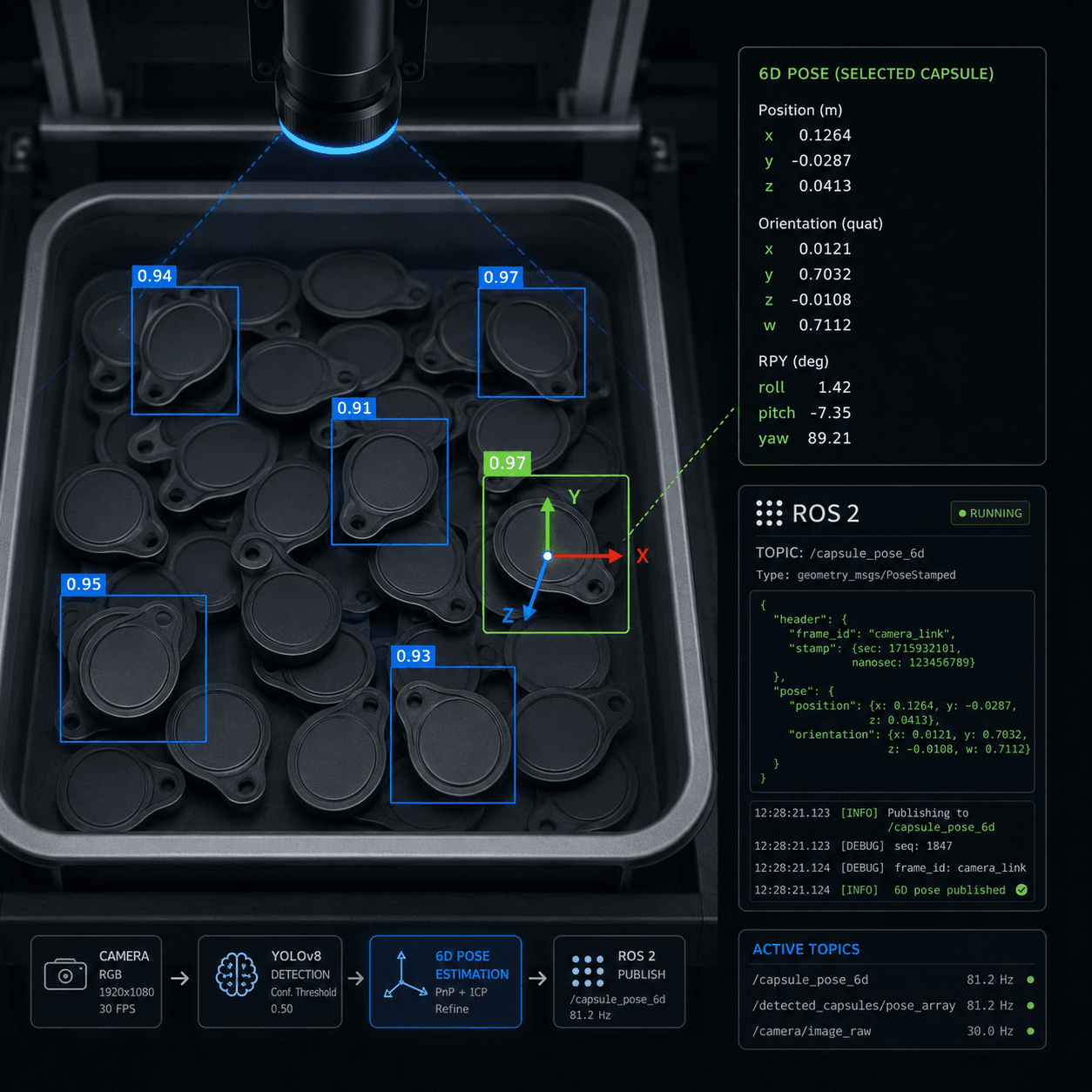
What the task looks like on the shop floor
Many manufacturing tasks start from a bin, a tray or a box of loose parts. An operator picks each part, orients it and places it into a machine, a fixture or a packaging line. The task is simple for a person and hard for classic automation: fixed fixtures cannot handle parts that are randomly piled, overlapping or partially hidden.
Vibratory feeders and mechanical orientation devices solve this for some part families, but they are format-specific, noisy, and expensive to change when the product changes.
Typical situations
- Parts delivered loose in bins, trays or boxes
- Manual loading of machines, fixtures or lines from bulk parts
- Feeders that need re-tooling for every product variant
- Parts that are reflective, dark, thin or entangled
- Cycle time and reliability depend on the operator
When a robotic application makes sense — and when it does not
An honest fit check is the first thing we do. Not every task needs a robot, and not every robot task needs vision.
It usually makes sense when
- Parts arrive in bulk and must be singulated and oriented before the next process step
- The same station handles several part references or frequent format changes
- A 6-axis robot with a suitable gripper can physically reach and grasp the parts
- Some cycle-time margin exists, or a small buffer decouples the robot from the line
- Part families are stable enough to build a reliable detection model
It usually does not make sense (yet) when
- Parts are so entangled that even a person needs two hands to separate them
- Cycle time is well below one second per part with no buffer possible
- A simple mechanical feeder already does the job reliably for a single, stable part
- Grasp surfaces are inaccessible for any realistic gripper or suction cup
- Lighting or part appearance cannot be controlled at all
What we typically use
- 6-axis industrial robots
Reach, payload and speed sized to the bin and cycle time
- 2D/3D vision systems
Structured-light or stereo 3D cameras, RGB-D, or 2D vision for flat parts
- Pose estimation
Part detection, 6D pose and grasp-point selection on real parts
- Grippers and suction
Vacuum, mechanical or hybrid end-effectors chosen per part geometry
- Digital twin validation
Reach, collision and cycle checks on the real bin and cell layout
- PLC / robot integration
Handshake with the downstream machine, bin change and error recovery
From task to validated robotic application
We start from the production task, not from the robot. Each step reduces technical risk before the next investment.
- Step 01
Assessment on your parts
We start from your real parts, bins and downstream process: how they arrive, how they must be placed, cycle time, and what happens when a pick fails.
- Step 02
Perception feasibility
We test detection and pose estimation on samples of your parts under realistic lighting before committing to a camera or robot.
- Step 03
Digital twin and pilot
We validate reach, collisions and cycle assumptions in simulation, then build a small pilot with the real gripper, camera and parts.
- Step 04
Integration and deployment
We integrate the application with the PLC-controlled machine or line, together with mechanical, electrical and safety partners when needed.
Related services: Robot Application Assessment, Digital Twin Validation, Robotic Pilot Cell, PLC / Robot Integration.
Often combined with
- Vision-Guided Pick & PlaceRobot applications where part position, orientation or format changes and vision is required before motion.
- Machine TendingRobotic loading and unloading of machines, fixtures, trays, stations and process equipment.
- SortingRobotic or vision-guided sorting of parts, products or packaging formats.
- Digital Twin ValidationSimulation-based validation of robot reach, collisions, cycle assumptions, layout and process logic.
Have parts arriving in bins or trays?
Send a photo or short video of the parts and how they arrive. We can tell you whether vision-guided bin picking is a realistic option and what the first technical step would be.